

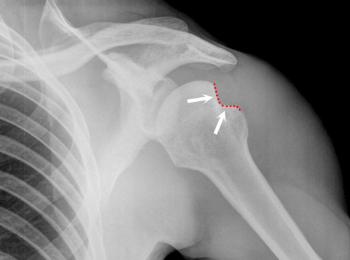
Hill Sachs Lesion
A Hill Sachs lesion, also known as a Hill-Sachs impaction fracture or Hill-Sachs defect, is an injury to the back part of the bone in your upper arm. It is named after two radiologists who first described the injury in 1940, Harold Hill and Maurice Sachs.
What is Hill Sachs Lesion?
A Hill Sachs lesion is a posterolateral humeral depression fracture that occurs in association with an anterior instability or dislocation of the glenohumeral joint. When the humerus pops out in a forward motion during a shoulder dislocation, it can scrape the edge of the bone against the socket in the shoulder, creating a 'dent' or lesion in the back part of the humerus.
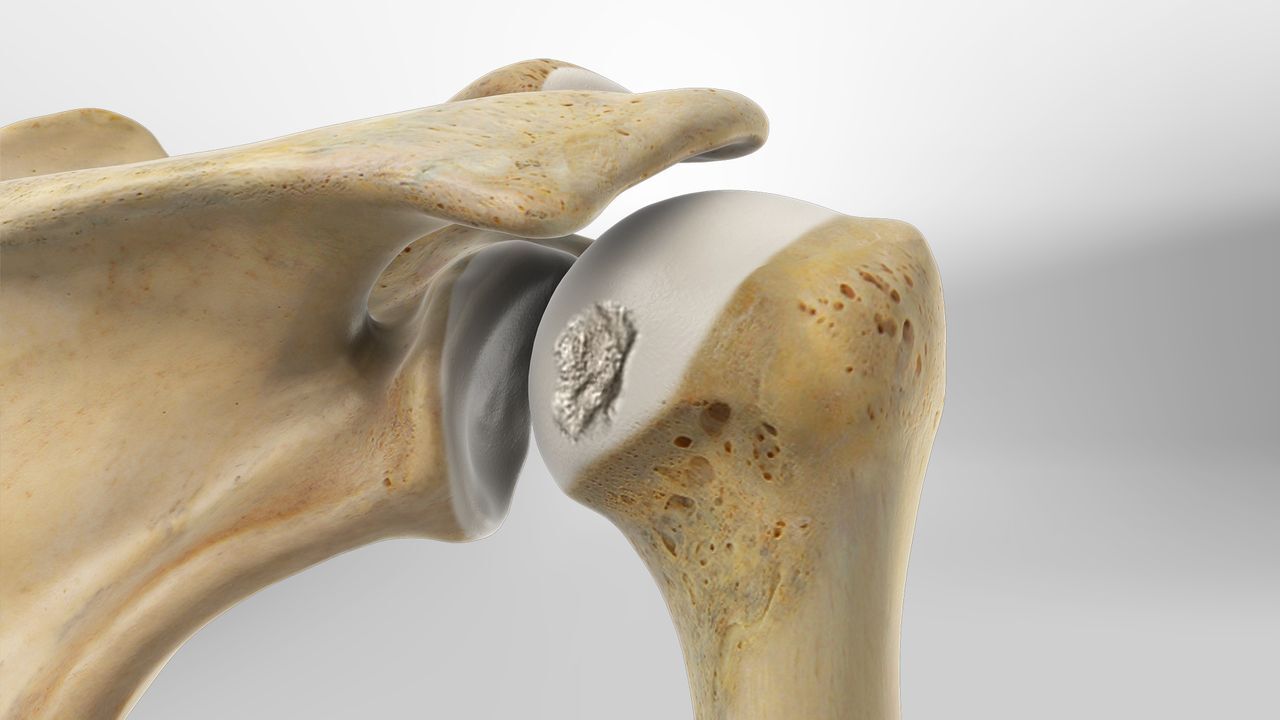
Hill Sachs Lesion
Signs and Symptoms of Hill Sachs Lesion
A Hill Sachs lesion occurs on the dislocation of the shoulder. It may not be apparent if you have a Hill Sachs lesion; however, you will feel the symptoms of a dislocated shoulder, such as:
However, a dislocated shoulder has a higher recurrence after the first injury. If proper treatment and rehabilitation are not practised, there is a strong likelihood for the lesion to become larger and a higher grade, as the shoulder becomes re-injured.
The classification of Hill Sachs Lesions are as follows:
There is also a greater likelihood of developing other bony defects, such as Bankart lesions - these being up to 11 times more likely to occur in patients with a Hill Sachs Lesion.
Causes of Hill Sachs Lesion
Hill Sachs Lesions are mainly caused by the anterior dislocation of the shoulder - about 47-50% of lesions are associated with this. As such, Hill Sachs lesions are commonly caused due to falls, sports activities and trauma.
It can also be seen in people with previous history of bony defects. For example, it is 2.5 times more likely for people with either a Bankart Lesion or a Hill Sachs Lesion to have the other type of lesion as well.
Lastly, it can occur in patients who have recurring shoulder instabilities, leading in anterior glenoid bone loss.
Statistics and Epidemiology related to Hill Sachs Lesion
In a study of people with dislocated shoulders, 71.9% had a Hill Sachs lesion. Other studies have shown between 40-90% of anterior dislocations, and as much as 100% in patients with recurrent anterior dislocations. A study looking into this found Hill Sachs lesions in 65% of acute dislocations, and 93% in patients with recurrent instability.
References:
Provencher MT, Frank RM, LeClere LE, Metzger PD, Ryu JJ, Bernhardson A, Romeo AA. The Hill-Sachs lesion: diagnosis, classification, and management. Journal of the American Academy of Orthopaedic Surgeons 2012;20(4):242-52.
Yiannakopoulos CK, Mataragas E, Antonogiannakis E. A comparison of the spectrum of intra-articular lesions in acute and chronic anterior shoulder instability. Arthroscopy: The Journal of Arthroscopic & Related Surgery 2007;23(9):985-90.
Calandra JJ, Baker CL, Uribe J. The incidence of Hill-Sachs lesions in initial anterior shoulder dislocations.Arthroscopy: The Journal of Arthroscopic & Related Surgery 1989;5(4):254-7.
Widjaja AB, Tran A, Bailey M, Proper S. Correlation between Bankart and Hill‐Sachs lesions in anterior shoulder dislocation. ANZ journal of surgery 2006;76(6):436-8.
ncbi.nlm.nih.gov/pmc/articles/PMC4799163/
How MHC Treatment Options Can Help Condition Title
Enter your text here...
Shoulder Recovery Program
Lorem ipsum dolor sit amet, consectetur adipisicing elit, sed do eiusmod tempor incididunt ut labore et dolore magna aliqua.
Schedule an Appointment Today
If you want to be free from Shoulder Pain don’t hesitate to call us to book a “Your Motion Matters” Initial Case Review today, for a pain free tomorrow.
